
AI is gaining more ability to act, but responsibility for the consequences still sits with people. Today's briefing leads with the UK cyber chief's infrastructure warning, then examines fresh financial disclosures, a major connectivity deal and the limits behind new agent demonstrations.
UK cyber chief warns of AI attacks on critical infrastructure by 2028
Britain is likely to face AI-enabled cyberattacks on critical infrastructure by 2028, NCSC chief Richard Horne has warned, according to Associated Press reporting. The concern includes ransomware and the faster exploitation of longstanding weaknesses, not just entirely new attack techniques.
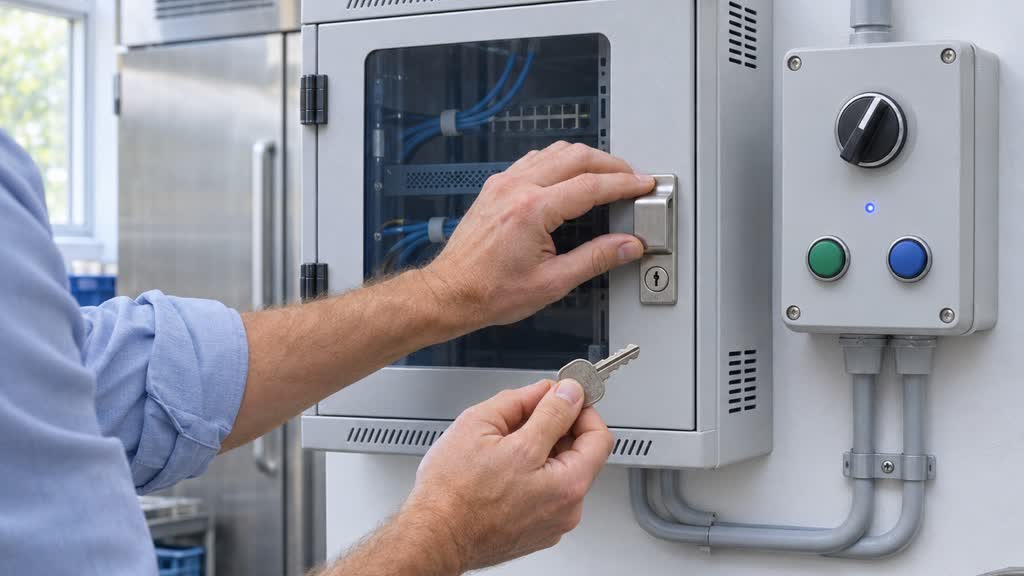
For UK businesses, the exposure extends beyond office computers to refrigeration, manufacturing equipment and other connected operational systems. The NCSC is urging organisations to update devices, restrict administrator access and back up important data.
Our take: Start with the systems that keep the business operating. Identify remotely accessible controls, assign an owner to patching and test whether you can restore operations without your main network. Buying another AI product will not compensate for neglected access controls.
Anthropic discloses $17 billion in quarterly revenue
Anthropic updated its IPO prospectus on Monday, reporting roughly $17 billion in third-quarter revenue and $33.24 billion for the first nine months of the year, CNBC reports. The revised filing also sets out $895.4 billion in purchase commitments and lease agreements.
The new quarterly disclosure gives buyers a clearer view of the scale behind Claude. Revenue, future contractual commitments and cash available today are different measures and should not be treated interchangeably.
Our take: Vendor growth does not remove supplier risk. If Claude is becoming operationally important, keep prompts and business records portable, document fallback arrangements and review pricing assumptions before committing more workflows.
Marvell agrees $115 billion Lumentum deal for AI connectivity
Marvell has agreed to acquire optical-components maker Lumentum in an all-stock transaction with an implied enterprise value of $115 billion. CNBC reports that Lumentum shareholders would receive 4.5 Marvell shares per share, with completion expected in the first half of 2028.
The deal targets the electrical and optical connections linking AI chips and systems. It remains an agreement awaiting completion, and its value moves with Marvell shares.
Our take: The AI infrastructure race is not only about processors. Connectivity, power and supply-chain concentration also shape availability and cost. Treat a proposed merger as a long-term capacity signal, not a promise of cheaper cloud services next month.
Meituan releases LongCat-2.5 for sustained coding tasks
Meituan released LongCat-2.5 on 2 November with visual and text capabilities aimed at extended agent tasks. TechNode reports 1.6 trillion total parameters, with approximately 48 billion activated per token, and training focused on complex codebases and longer task sequences.
The model is available through the company's chat service and API, while GitHub and Hugging Face releases are planned. Planned releases should not be confused with an already available open-weight package.
Our take: Evaluate any coding model on a bounded task from your own software, including tests and a review of its changes. Parameter counts are not evidence that an agent can safely maintain a production business system.
Researchers demonstrate direct editing of neural-network weights
Researchers have published early experiments in weight-space programming, asking a general-purpose language model to inspect and change another network's weights directly rather than through gradient descent. One reported experiment raises Qwen3.5-0.8B's MATH-500 result from 7.9% to 48.1%.
The work includes small networks and a small language model. It is an experimental research result, not evidence that arbitrary business models can now be reliably repaired without training.
Our take: This is worth watching, not budgeting around yet. A striking benchmark improvement still needs independent reproduction, checks for regressions and evidence that the technique works beyond selected tasks.
CUA-Master reports 80.2 on a computer-use benchmark
A new research paper introduces CUA-Master, a 27-billion-parameter computer-use agent trained through a recursive data-improvement framework. The authors report 80.2 on OSWorld Verified, 43.9 on WeaveBench and 25.0 on Agents' Last Exam.
The system draws seed tasks from instructional videos and reconstructs workflows, then uses model weaknesses to guide further training. These are author-reported benchmark results, not a measured success rate on a UK company's own processes.
Our take: The gap between benchmarks is useful context: there is no single number for general office reliability. Test the exact application, permissions and recovery path you need, and require approval before an agent sends messages or changes financial records.
SenseTime targets office and design work with SenseNova 6.8 Flash
SenseTime released the official version of SenseNova 6.8 Flash on 2 November, TechNode reports. It supports tasks including presentations, posters, websites, SVG graphics and 3D creation through tools such as Blender.
The company is also promoting longer-term memory and collaboration across conversations. Importantly, the separate demonstration of memory and proactive collaboration used an internal development version, rather than establishing that every feature is in the public release.
Our take: Ask vendors to show the shipped product rather than a development demonstration. For design work, assess editable outputs, accessibility and rights to supplied assets; for memory features, establish what is retained and how a user can correct or delete it.