
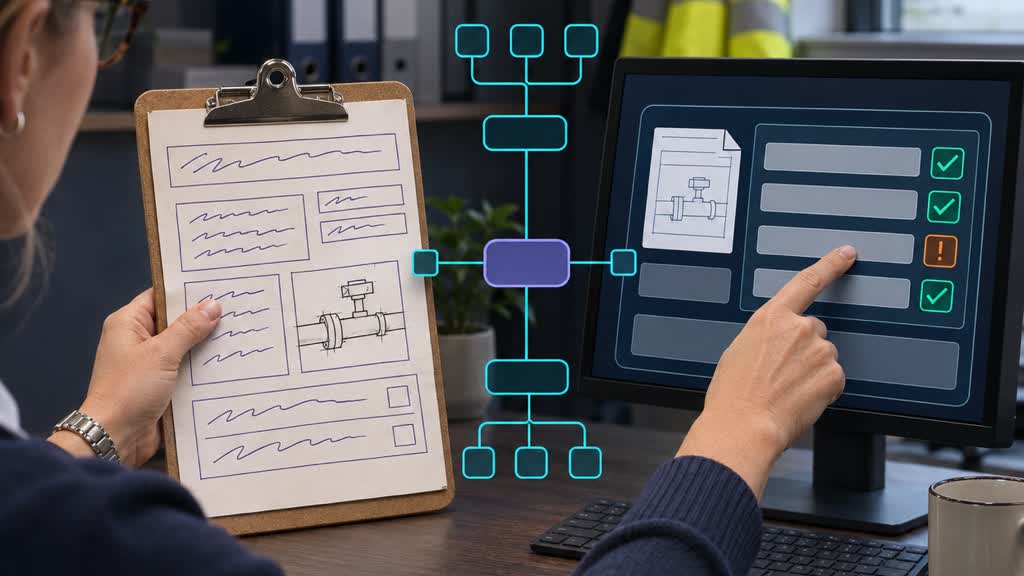
Yes, but readable text is not yet a reliable business record
Yes. AI can read many handwritten job sheets and propose structured records for your office team. The useful result is a checked draft linked to the original sheet, not an automatic invoice or an unverified declaration that work is complete. Illegible quantities, ambiguous dates and signatures still need people.
This is a buying decision about whether document extraction is suitable for your paperwork. It is not the same as asking a chatbot to tidy some notes. Your office needs a customer reference, a job reference, dates, labour, materials and exceptions in the right places. A fluent paragraph containing the wrong part number is worse than a clearly marked blank.
There is established technology behind the idea. Microsoft documents that Azure Document Intelligence Read extracts printed and handwritten text from scanned images and PDFs. That establishes a capability, not an accuracy guarantee for your engineers' handwriting. Its OCR stage does not by itself prove that an extracted number belongs to the correct job or that a customer approved an extra charge.
Expect a proposal to separate reading, field extraction, business validation and approval. If the supplier bundles those into one unexplained promise of automation, you cannot tell what is being tested. Ask to see your actual paperwork processed, including the sheets your office already finds difficult.
Which job sheets are a good fit, and which are not?
The strongest candidates have repeatable layouts, visible job numbers and handwriting that colleagues can generally read. An established repair or maintenance business with a daily pile of similar sheets has a clearer opportunity than a company receiving a handful of unrelated handwritten letters each month. Volume matters, but the cost of a mistake matters just as much.
Ask a prospective supplier to distinguish recognition from interpretation. Reading '2' is one task. Deciding whether it means two hours, two metres or two replacement valves requires context. A printed column label helps. A note written across several boxes, overwritten numbers or an unfamiliar abbreviation may not provide enough evidence.
Photographs introduce another variable. Folded paper, shadows, grease and missing corners can remove information before the AI sees it. A supplier who tests only clean scans has not tested the service you will actually use. Ask whether unreadable images are rejected visibly or quietly converted into plausible records.
Signatures require particular care. Detecting an ink mark or extracting a nearby name does not establish who signed, what they agreed to or whether the signature is genuine. Keep the original evidence and use your existing approval rules. Do not allow an AI-generated description of a signature to become a substitute for contractual acceptance.
Make the decision field by field. AI might be useful for a readable description while quantities remain subject to compulsory review. You do not have to choose between automating the whole sheet and doing nothing.
What should the supplier prove before you pay?
Ask for a small, paid or otherwise explicitly agreed evaluation using representative sheets, with the commercial terms clear beforehand. There is no universal sample size that establishes safety. As an illustrative starting point, 50 varied sheets can expose problems that a five-page demonstration misses; a larger and more demanding evaluation may be needed before live financial use.
Include different staff handwriting, old and new forms, blank fields, corrections, duplicate submissions and jobs with disputed notes. Have your own staff establish the correct answers. Testing the AI against answers produced by the same AI tells you very little.
Measure exact matches for the fields that drive decisions: customer identity, job number, quantities, rates, dates and completion status. Report missing values separately from wrong values. A system that says 'cannot read' gives your team a manageable exception; a confidently wrong quantity can become a customer dispute. An overall character recognition score can hide this difference.
Require a side-by-side review screen showing each proposed value against its source area. Reviewers need to correct, reject and return a sheet for clarification, not merely approve the complete output. The supplier should also show how duplicate uploads avoid duplicate jobs or invoices and how an interrupted import is recovered.
Agree acceptance criteria before integration. For example, your policy may require human approval of every chargeable quantity, regardless of confidence. That is a business control, not a claim that a particular numerical confidence score makes an invoice safe.
What is the real cost once checking is included?
Price the whole workflow rather than just the OCR calls. A quote should distinguish document processing, storage, capture equipment if needed, integration, review screens, user access, support and future changes to form layouts. Ask whether failed pages and repeated processing are charged, and who pays when the connection to your job-management software changes.
Here is illustrative arithmetic, not a supplier quotation or a claimed customer result. Suppose the office processes 400 sheets a month, taking six minutes each. That is 40 hours. If extraction plus checking reduces the average to three minutes, the gross saving is 20 hours. At an assumed loaded staff cost of £20 an hour, the released capacity is £400 monthly before software, support, set-up and exception handling.
If the combined recurring cost were £150 a month, that illustration would leave £250 of monthly capacity value. An illustrative £3,000 set-up cost would then take 12 months to recover on that narrow calculation. Neither price is a market benchmark. Change the assumptions to your own figures, and include management time and any extra rework.
Released capacity is not automatically cash saved. Unless expenditure falls or the time supports additional profitable work, describe it as capacity rather than a cash return. A faster office that must spend the same afternoon investigating incorrect parts has not achieved the promised benefit.
Compare the proposal with a structured mobile form, your existing field-service software and ordinary scanning plus manual entry. A simpler option can win even if its demonstration looks less impressive.
What UK data and record-keeping obligations still apply?
Job sheets may contain customers' names, addresses, signatures and employees' working patterns. Sending them to a document-processing service is a data-processing decision. Establish the purpose and lawful basis, limit unnecessary information, check the processing contract and subprocessors, and understand retention and any international transfers. A business subscription alone does not answer those questions.
The ICO's accuracy guidance says organisations should take reasonable steps to keep personal data accurate and make its source and status clear. Its named Royal Mail Postcode Address File example makes an important distinction: postal addresses reflect delivery arrangements, not necessarily county boundaries. For your office, an AI 'correction' that changes a customer's address to match an assumption can create a new error. Preserve what the source says and investigate discrepancies.
There is a separate financial-record issue. HMRC says VAT records generally need to be kept for at least six years, with ten-year requirements in specified OSS or MOSS circumstances. It also explains digital-record and digital-link requirements for Making Tax Digital for VAT. These rules do not mean every job sheet has the same retention period, nor that an AI transcription automatically satisfies them.
Where sheets support invoicing or tax evidence, agree retention and digital links with your accountant. Keep a traceable relationship between the image, reviewed extraction and final record. The ICO page is marked under review following the Data (Use and Access) Act, so check updated guidance when implementing rather than treating this article as a complete legal assessment.
When this is NOT right for you
Do not buy an AI extraction project merely because paper feels old-fashioned. If engineers can enter structured information once in an existing mobile app, avoiding handwriting may solve more of the problem. Check offline working, usability and staff training before assuming paper must stay forever.
AI is also a poor answer to forms that do not collect essential information. It cannot recover a missing labour rate, an unrecorded authorisation or a customer name nobody wrote down. Turning gaps into guessed values makes the record look complete while removing the warning your office needs.
Be particularly cautious where sheets contain safety-critical measurements, inspection outcomes or regulatory sign-offs. Extraction can support administration, but it must not replace the judgement and accountability of the qualified person. If the supplier cannot separate draft data from approved evidence, do not connect it to systems that certify completion.
The investment may not make sense at low volume, where the checking burden stays close to manual entry, or where an unsupported integration dominates the cost. Ask for an exportable trial result and a clear exit route rather than committing to a long contract based on a headline accuracy claim.
The sensible purchase is a reviewed record-capture service with known limits. If a supplier only offers automatic completion, billing and paper disposal as one package, keep looking. You should be able to retain human approval without being told that you are undermining the technology.
Is This Right for You?
This can fit a business with repeatable paper job sheets, measurable retyping effort and an office reviewer who can resolve exceptions. It is less suitable where a simple mobile form removes the problem, volumes are low or the source information is missing.
If you are comparing options, bring a few representative anonymised sheets and a list of the fields your office needs. Start with a practical suitability discussion, not a promise of complete automation.