
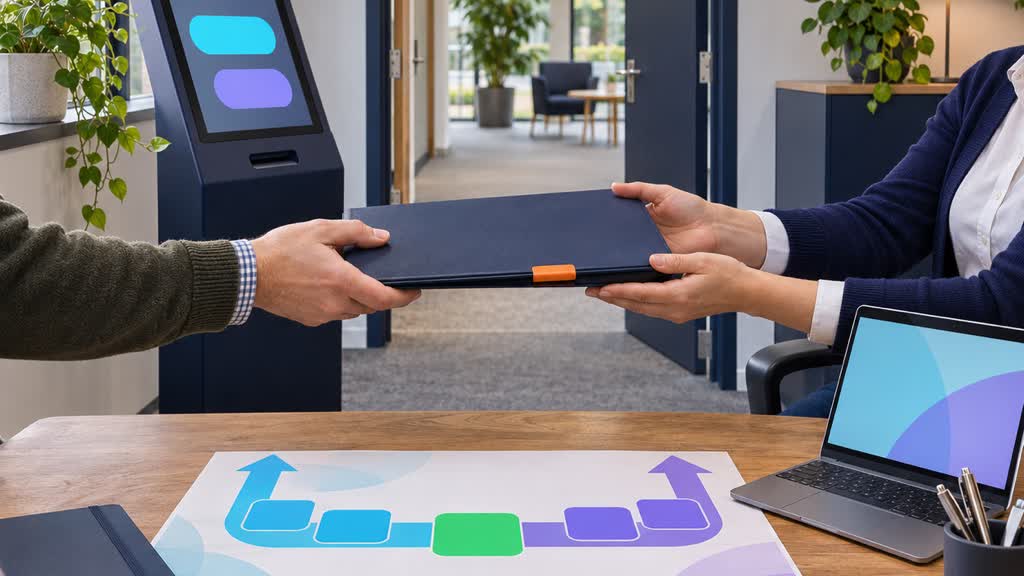
A human handover button means very little if nobody receives the case. Test the exit before celebrating the conversations your AI contains.
A human option changes the proposition
A customer who asks to speak to someone is not necessarily rejecting your technology. They may be trying to explain an exception, correct a misunderstanding or communicate in a way your interface does not support. If your AI responds with another suggestion instead of arranging help, the problem is no longer answer quality. It is service design.
Recent UK research makes that distinction worth taking seriously. TelcoNews reported Five9 research on 26 October 2026 involving 3,000 consumers across the UK, US and Germany, including 1,000 in the UK. Among UK respondents, 42% said they often or always had to repeat themselves when moving from AI to a human. That is a specific transfer problem, not evidence that every automated interaction fails.
Across all three countries, 55% said they trusted AI to resolve a service issue when a human option was available, compared with 26% without that option. These are reported attitudes in vendor-sponsored research, not a controlled demonstration that adding a button doubles commercial performance. They nevertheless challenge a common assumption: making human help visible does not automatically undermine confidence in automation.
For a business owner, the useful question is whether customers can leave the automated route without losing their place, their explanation or their preferred communication method. Put that question into the buying brief before comparing conversational fluency. A polished demonstration can conceal an unusable exit. Ask the supplier to demonstrate an unsuccessful interaction and the subsequent handover, using the same customer record throughout. Judge the complete journey rather than the chatbot's best answer.
A polished demonstration can conceal an unusable exit.
Define the handover as an owned service
An escalation is not complete when the AI says that somebody will get back to the customer. It is complete only when your organisation has accepted responsibility through a working process. That distinction matters particularly in small firms, where the same person may handle sales enquiries, complaints and account changes.
Write down the minimum handover record before changing prompts. It should identify the customer's request, what has already been tried, relevant verified facts, unresolved questions and the destination team. Include an actual case reference where your system supports one. Distinguish facts supplied by the customer from interpretations produced by AI. A plausible summary that silently changes the requested remedy creates work rather than saving it.
What this means in practice: a customer requesting an exception to a cancellation policy should not receive an invented promise that a manager has approved it. The automation can record the request and route it to someone with the relevant authority. The receiving person needs the original wording available alongside a short summary, with access restricted appropriately. Your existing limits on personal information processing still apply during that transfer.
Set ownership and service hours explicitly. If the account team is closed, say so and offer a realistic next step. Do not let the model generate a callback time from conversational habit. A callback promise should depend on real capacity or an approved service commitment.
Start with features already present in your helpdesk or CRM rather than building a second case-management system. Check assignment rules, transcript access, notification delivery and out-of-hours handling in the exact configuration you use. An integration labelled human handover is a starting point for testing, not proof that a person has accepted the case.
An escalation needs an owner, not just a reassuring sentence.
Accessibility is not a sentiment score
Some customers cannot comfortably use a voice interface. Others may struggle with small text, complex instructions, rapid timeouts or repeatedly rephrasing a request. A system that waits for sufficiently negative sentiment before offering help can miss all of those barriers. People should not have to become angry, or disclose a diagnosis, to reach an alternative channel.
Keep a clear route to human assistance visible from the outset and honour straightforward requests for it. Design alternatives around the customer's communication needs rather than assuming that a telephone call is universally accessible. An email route, accessible web form or supported relay option may be more useful, depending on the service and the individual. Publish only channels you actually monitor.
The government's Equality Act guidance explains the framework applying in England, Scotland and Wales and links separately to Northern Ireland guidance. Service providers need to consider their applicable reasonable-adjustment duties. This is not a claim that every chatbot must offer an identical interface or that every customer request establishes a legal entitlement to instant telephone support. The practical point is to assess barriers and adjustments deliberately, not treat automation as an exemption from existing responsibilities.
What this means in practice: test whether someone using only a keyboard can request assistance, understand the response and retain their case reference. Check whether a screen reader announces newly added messages and whether a timeout erases an unfinished explanation. Include customers with relevant access needs in evaluation rather than assuming internal staff can represent every experience.
Avoid using AI to infer medical conditions from writing style. Ask what communication support is needed, collect only necessary information and apply appropriate handling controls. Accessibility should improve the route to help, not become another source of unnecessary sensitive records.
People should not have to become angry to reach an alternative channel.
Transfer context without pretending it is verified
A transcript dump is not automatically a good handover. It can overwhelm the receiving colleague, expose unnecessary personal information and leave important contradictions buried. A generated summary has the opposite risk: it may look tidy while omitting the detail that makes the case unusual. Use a short structured summary with access to the relevant original material, not an unreviewable replacement for it.
Separate the customer's requested outcome from what the AI suggested. Record whether identity checks were actually completed through your approved process. If an external lookup failed, preserve that uncertainty rather than allowing the summary to imply that the account was checked. Do not treat a model's confident tone as evidence of verification.
A November report of TCN's survey of 1,000 UK adults found that 41% identified speaking to several people or departments as a leading customer-service frustration, while 40% cited disconnection and having to start again. The survey is another supplier-backed snapshot, not an audit of your own operation. Its relevance is the customer burden it identifies: repeating a difficult explanation is part of the cost of a broken transfer.
Create a deliberately awkward test case. Have the customer correct an earlier statement, reject a suggested solution and ask for written contact instead of a call. Then inspect what the colleague receives. Does the latest correction survive? Is the rejected suggestion clearly marked as rejected? Is the communication preference visible without searching the whole conversation?
Keep a traceable case reference across the transition. If a notification fails, the case should still be discoverable in the receiving team's normal workflow. A successful API response to one integration step is not sufficient evidence that the customer now has a usable route to resolution.
The summary must preserve corrections, not just compress the conversation.
Do not confuse fewer conversations with better service
There is a legitimate counterargument: human assistance costs money, and allowing immediate escalation may reduce the apparent savings from automation. A small business cannot staff every channel around the clock. Those constraints are real. They justify clear service hours and sensible routing, not hiding the exit or counting abandonment as success.
Measure what happens after the automated interaction. A customer who closes the window may have found the answer, given up or decided to contact you elsewhere. Without follow-up evidence, those outcomes are not interchangeable. Track repeat contact for the same issue, unresolved complaints, time to accepted human ownership and whether customers have to repeat essential information. Use a defined observation period and compare similar types of case.
TCN's October 2026 consumer survey summary discusses payment-channel preferences and AI implementation together. That is a useful reminder that service choices depend on context. Do not extrapolate preferences about a routine enquiry into permission to automate a sensitive account conversation. Nor should a general preference for human support mean abandoning useful self-service for customers who want it.
Set a review rule for the early pilot: examine a sample of apparently resolved automated contacts as well as escalations. Otherwise the dashboard will show the visible handovers while concealing the customers who disappeared. Ask whether the eventual remedy was correct and whether the customer could access the process without avoidable difficulty.
Report savings after the cost of transferred work, repeat contacts and review. A model that handles fewer cases autonomously but sends the right information to the right person may be commercially better than one with an impressive containment rate. Make that comparison with your own evidence rather than a supplier's headline percentage.
Hiding the exit can improve a dashboard while making the service worse.
Run the exit test before widening the pilot
You do not need a large transformation programme to test this properly. Choose one customer journey with a clear owner, bounded authority and manageable consequences. Document the current human route, then place the AI alongside it rather than removing the fallback on day one. Keep the ability to suspend the automated route without suspending customer support.
Build a test set covering a direct request for a person, repeated misunderstanding, a correction, an unavailable team, a failed transfer notification and an access need. Add a sensitive complaint and a request outside the system's authority. These are proposed operational tests, not claims about the performance of any particular product. Agree what a satisfactory outcome looks like before running them.
Recent industry coverage also puts customer care alongside technical developments. CXM's 16 October roundup reported Octopus Energy's recognition for care of customers in vulnerable circumstances at the UK Customer Experience Awards. An award does not prove a particular AI design works, but the example is a useful counterweight to treating automation volume as the definition of service quality.
Give the test to someone outside the implementation team. Ask them to request help using ordinary language, not the exact phrase the demonstration expects. Follow the case into the receiving team's actual workflow and check the reply the customer receives. Repeat outside normal service hours. Record defects and retest the failed journeys before expanding traffic.
Finally, assign an operational owner who can change routing rules, update service information and stop a misleading promise. Recheck the exit after supplier upgrades or workflow changes. Your customer does not experience a model, a connector and a support queue as separate products. They experience one business. The human handover is part of that business's service, and it needs the same care as the automated answer.
Test the failed conversation all the way to the person who must resolve it.
Key Takeaways
- Test a direct request for a person before expanding any customer-facing AI pilot.
- Give each transferred case an owner, a reference and a truthful service-hours response.
- Preserve customer corrections and communication preferences alongside relevant original context.
- Test keyboard access, screen-reader behaviour and alternatives to voice-only support.
- Measure repeat contact and unresolved cases rather than treating abandonment as resolution.