The short answer for buyers
Compare AI agency proposals by normalising the outcome, scope, responsibilities, assumptions, data work, testing, ownership, support and total cost. A polished demonstration is evidence of a demonstration, not proof that the proposed system will work safely with your people and data.
The proposal should carry the weight
The proposal should carry the weight. It should explain the business problem, the workflow, the data sources, the integration route, the risks, the acceptance tests, the rollout plan, the support model and the real cost. If the demo is exciting but the proposal is vague, believe the proposal. Vague on paper usually becomes expensive in delivery.
This matters because UK AI adoption is still uneven. The Department for Science, Innovation and Technology's 2025 AI Adoption Research, based on 3,500 business interviews, found that around 1 in 6 UK businesses currently use at least one AI technology. Among adopters, 85% use natural language processing and text generation, while agentic AI adoption is only 7%. In plain English: lots of agencies can demonstrate generative AI, but far fewer have repeated evidence of production-grade agentic systems.
The ONS Management and Expectations Survey found that AI was adopted by 9% of UK firms in 2023 and projected to reach 22% in 2024. The most common barriers were difficulty identifying use cases at 39%, cost at 21% and AI expertise or skills at 16%. Those numbers explain why demos are persuasive. Buyers want confidence. The problem is that confidence is not the same as delivery evidence.
Do not compare proposals by feel
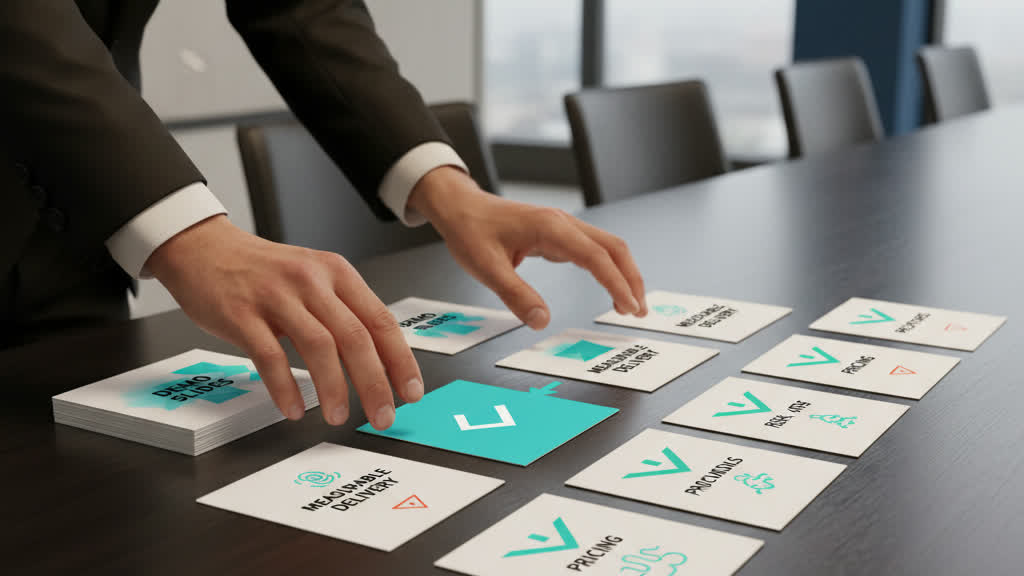
Do not compare proposals by feel. Build a simple weighted scorecard and tell each agency how they will be assessed. Good agencies will welcome it. Weak agencies will try to steer you back to the demo.
| Area | Weight | What good looks like | Red flag |
|---|
Score each category from 1 to 5, multiply by the weighting, and compare totals. Do not allow one dazzling demo to compensate for a missing data protection plan or unclear ownership. If a project touches personal data, customer communication, HR, finance, regulated advice or operational decisions, risk and governance should carry more weight than interface polish.
The most important question is simple
The most important question is simple: what has to be true for this demo to work in our business every day?
Make each agency answer that question in writing. Their answer should cover data access, permissions, prompt or model design, integration with tools such as Microsoft 365, Google Workspace, HubSpot, Xero, Shopify, Sage, Slack, Teams, your CRM or your helpdesk, exception handling, human approval and monitoring after launch.
A good agency will say things like: this will not work until your CRM fields are cleaned, this customer workflow needs human approval at two points, this should start as an internal assistant before it becomes customer-facing, or this part is better solved with rule-based automation than AI. That honesty is a strength, not a weakness.
A weak agency will keep the conversation at demo level. They will say the model can understand anything, integration is straightforward, or the system learns over time without explaining from what data, under what controls, and who is accountable when it gets something wrong.
Demos hide the boring work because the boring work is what makes the system usable
Demos hide the boring work because the boring work is what makes the system usable. That includes data cleaning, permission design, integration testing, staff training, error monitoring, documentation and support. These are not extras. They are the project.
Look for seven hidden cost lines:
- Data preparation: cleaning spreadsheets, CRM fields, documents, product data or helpdesk content.
- Integration work: connecting APIs, middleware, webhooks, Zapier, Make, n8n, Power Automate or custom code.
- Security review: access controls, vendor checks, data processing terms and role-based permissions.
- Testing: real user testing, edge cases, hallucination checks, load checks and fallback scenarios.
- Change management: training staff, redesigning the workflow and updating internal processes.
- Ongoing running costs: model usage, licences, cloud hosting, monitoring, support retainers and maintenance.
- Exit costs: export of data, documentation, IP ownership, handover and removal of vendor dependencies.
If those lines are missing, the proposal is incomplete. The agency may still be competent, but you do not yet know the cost of buying from them.
This is also where UK regulation matters. The Competition and Markets Authority's AI Foundation Models review highlights principles around competition, consumer protection, transparency, accountability and governance. For buyers, the practical lesson is not abstract. Avoid proposals that lock you into one model, one platform, one black-box workflow or one supplier without a sensible exit route.
Technical talent matters, but production evidence matters more
Technical talent matters, but production evidence matters more. A clever prototype built by one senior developer is not the same as a reliable system used by a team every day.
Ask for three types of evidence. First, live or recently live examples that are similar in risk and complexity to your project. They do not have to be in your exact sector, but they should involve comparable data, users and operational pressure. Second, named references you can speak to. If confidentiality prevents naming the client publicly, a private reference call should still be possible for serious procurement. Third, evidence of support after launch: service levels, response times, monitoring routines, documentation and training materials.
Also ask about failures. A serious AI agency should be able to explain projects that did not proceed, pilots that failed, assumptions that turned out wrong, and what they changed as a result. If every story is a perfect success, you are probably hearing sales copy rather than operational truth.
Be fair to different agency types. Accenture, Deloitte, PwC and IBM can handle large enterprise programmes, governance-heavy environments and global change management, but they may be too expensive and slow for a 20-person SME. Specialist boutiques can move faster and cost less, but may have limited capacity or narrower expertise. No-code automation consultants can be excellent for workflow speed, but may not be right for regulated, security-heavy or deeply custom systems. The right choice depends on the risk of the work, not the shine of the demo.
Put these questions into your procurement process
Put these questions into your procurement process. Do not save them for the final call.
- What exact business metric will this project improve, and what is the current baseline?
- What data will the system use, where is that data stored, and who can access it?
- What happens when the AI gives a wrong answer?
- Which parts are deterministic automation and which parts are probabilistic AI?
- What will we own at the end: prompts, workflows, code, documentation, data structures and accounts?
- What will still cost money after launch?
- What is excluded from the fixed price?
- How do we leave if the relationship does not work?
- Who on your side is actually doing the work?
- Can we speak to a client whose project is live, not just demonstrated?
Listen for specificity. A strong answer includes names, numbers, tools, stages and trade-offs. A weak answer uses phrases like enterprise-grade AI, seamless integration, cutting-edge intelligence or transformation at scale without explaining what will happen on Tuesday morning when your staff log in.
If two proposals are close, choose the one that is clearer about limits. The agency that admits a pilot may show no ROI is usually safer than the agency that promises a guaranteed productivity uplift before seeing your workflow.
You do not need a heavy procurement process for every AI purchase
You do not need a heavy procurement process for every AI purchase. If you are buying ChatGPT Team, Claude Team, Microsoft Copilot, Gemini for Workspace, Grammarly, Fireflies, Fathom, Zapier, Make or another low-cost SaaS tool for a small group, a practical trial is usually enough. Set a budget, test for 30 days, check data rules, then keep or cancel.
This framework does apply when the agency is proposing custom workflows, customer-facing AI, data integration, CRM automation, internal agents, document processing, financial analysis, HR support, regulated content or anything that could damage trust if it fails. At that point, the risk is no longer the software subscription. The risk is operational dependency.
If you want a practical next step, ask each agency to resubmit its proposal using your scorecard. Give them one page for business outcome, one page for delivery plan, one page for risk and governance, one page for pricing and one page for evidence. The best partner will become easier to spot very quickly.
If you want a second pair of eyes on proposals before you sign, book a free call. No pitch, no pressure. We will help you separate real delivery evidence from demo theatre.
Related buying guidance
For the related buying decision, read Which criteria should I use to compare AI agency partners?.
For the related buying decision, read How can AI help me compare quotes, supplier terms or proposals without making the decision for me?.
Browse the comparisons guidance pillar for more buyer questions.
Is This Right for You?
This applies if you are comparing two or more AI agencies, automation consultants, Microsoft Copilot partners, OpenAI integrators, no-code automation specialists or broader digital agencies that now sell AI services. It is especially useful if the demos look impressive but the proposals feel hard to compare.